 How-to
Why Electrical Fire Prevention Is Critical for Offices
Last Updated: 4 November 2026
Quick Summary
Electrical fire prevention matters in offices because faults often hide for months, behind desks and inside walls, before smoke appears. Offices are packed with devices and cables all drawing power, so overloaded sockets, damaged equipment and charging habits create real risk, which regular checks and maintenance help reduce.
- Electrical faults hide behind furniture, under desks and inside cable trunking
- Never daisy-chain extension leads or plug one adaptor into another
- Charge lithium-ion devices on hard, clear surfaces, never on beds or sofas
- Report burning smells, sparks, warm plugs or repeatedly tripping breakers straight away
- Book an EICR, typically every five years for many commercial premises
Table of Contents
- Why Electrical Fires in Offices Are Harder to Spot Than You Think
- Common Causes of Electrical Fires in Offices
- Modern Office Risks: Lithium-Ion Batteries, USB Charging and Hybrid-Working Kit
- Electrical Fire Warning Signs Staff Should Never Ignore
- Office Electrical Safety Checklist: Prioritised Prevention Steps
- Legal Duties, Good Practice and Technical Standards Explained
- EICR for Commercial Premises: What Inspections Cover
- Booking Your Next Office Electrical Inspection
- Frequently Asked Questions
Why Electrical Fires in Offices Are Harder to Spot Than You Think
Electrical fire prevention is the set of checks, habits and maintenance tasks that stop an electrical fault from becoming a blaze. For most office managers, it sits low on the to-do list until something goes wrong. The warning signs of electrical faults are often present for months before anyone acts.
Offices feel safe. There are no open flames, no cooking equipment and no industrial machinery. Yet a typical office is packed with devices, cables, chargers and power strips, all drawing power at once. Each one adds load to the same circuits.
The hard part is that electrical faults rarely announce themselves. A cable can overheat quietly behind a desk. A socket can scorch slowly inside a wall. By the time smoke appears, the damage is often well underway.
- Faults hide behind furniture, under desks and inside cable trunking
- Staff tend to get used to small problems like flickering lights or warm plugs
- Nobody owns the job, so checks slip between departments
Treating electrical safety as an ongoing task, not a one-off job, is the first step.
Common Causes of Electrical Fires in Offices
Most office electrical fires start from a small number of causes. Knowing them makes prevention far more practical.
Overloaded Sockets and Extension Leads
Extension leads and multi-way adaptors are common in offices, but they are easy to overload. Plugging several heaters, printers and chargers into one lead can push more current through the cable than it was built to carry.
- Never daisy-chain extension leads or plug one adaptor into another
- Keep high-power items such as heaters and kettles on their own fixed socket
- Look for scorch marks or a warm casing on any lead in regular use
Faulty and Poorly Maintained Equipment
Damaged leads, cracked plugs and worn appliances are a frequent source of trouble. A frayed cable can cause a short circuit, and dust build-up inside printers and computers can cause overheating.
Portable Appliance Testing (PAT) checks that portable equipment is safe to use (PAT (Portable appliance testing)).
Lighting Placed Too Close to Combustible Materials
Desk lamps and ceiling fittings can get hot. When they sit near paper, fabric or stacked files, the risk grows. Make sure lighting has clear space around it and that heat can escape.
Modern Office Risks: Lithium-Ion Batteries, USB Charging and Hybrid-Working Kit
Modern offices carry risks that older guidance does not cover. Laptops, tablets, phones, power tools and e-bike batteries all use lithium-ion cells. These batteries store a lot of energy in a small space.
- Charge devices on a hard, clear surface, never on a bed, sofa or pile of papers
- Do not leave devices charging unattended overnight in a crowded area
- Replace swollen or damaged batteries straight away
- Use the manufacturer's charger rather than a cheap replacement
Hybrid working adds another layer. Staff may bring equipment home or set up makeshift workstations. Ask employees to report any equipment they use off-site so it can be included in your checks.
Electrical Fire Warning Signs Staff Should Never Ignore
Staff are often the first people to notice a problem. Encourage them to report any of the following straight away, rather than waiting to see if it passes.
- A burning smell, especially near a socket or device
- Scorch marks or discolouration on plugs, sockets or leads
- Sparks or crackling when a plug is inserted or removed
- Lights that flicker, dim or buzz
- Sockets or plugs that feel warm or hot to the touch
- Circuit breakers that trip repeatedly
If any of these appear, switch off the equipment if it is safe to do so, unplug it, and report it to the person responsible for electrical safety. Do not try to repair it yourself.
Office Electrical Safety Checklist: Prioritised Prevention Steps
A checklist only works if it is ordered by risk and tied to a named person. The sequence below puts the highest-consequence, lowest-effort checks first, then moves to tasks that need a qualified electrician or a budget line. Adapt the frequencies to your premises, but keep the order.
Daily and weekly checks (staff and office manager)
- Visual sweep of leads and plugs. Look for fraying, crushed cables, scorch marks, cracked plugs and loose cord grips. Anything damaged should be taken out of use and labelled.
- Clear combustibles from heat sources. Paper, cardboard, fabric and stacked files should not sit against lamps, heaters, printers or socket outlets.
- Check charging habits. Devices should charge on hard, clear surfaces, not on soft furnishings or under piles of paper. Unattended overnight charging in shared areas should be discouraged.
- Confirm vents and fans are unobstructed on computers, printers, copiers and any portable heaters.
- Log every fault report with the date, the item, who reported it and the action taken. A shared spreadsheet is enough; the point is that nothing gets lost between shifts.
Monthly checks (office manager or facilities lead)
- Review extension lead use. Remove daisy-chained adaptors, move high-power items such as heaters and kettles onto fixed sockets, and replace any lead with a warm casing or discolouration.
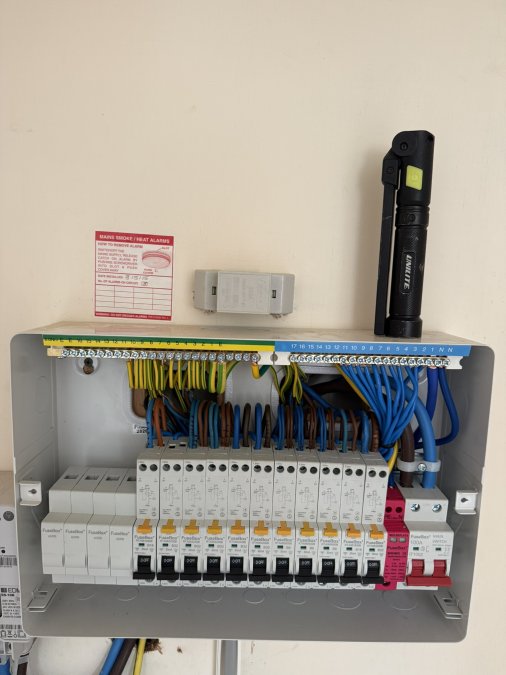
- Inspect the consumer unit area. Confirm the area is clear, labelled and accessible, and that residual current devices (RCDs) trip when tested using the test button.
- Check portable heaters and fans are not placed where they can be knocked over or covered, and that they are switched off when the office is empty.
- Review near-miss reports and look for patterns, repeated tripping on one circuit, recurring warm plugs or flickering lights usually point to a fault that needs an electrician.
Quarterly and annual checks (responsible person and contractor)
- Book Portable Appliance Testing (PAT) for portable equipment at a frequency that reflects use and risk. Testing frequency should reflect how equipment is used and its level of risk.
- Arrange an Electrical Installation Condition Report (EICR) at the interval recommended by your electrician, typically every five years for many commercial premises, or sooner if the installation is older, has been altered or shows signs of deterioration.
- Close out remedial defects from the EICR and PAT reports, and record the date each item was fixed.
- Refresh staff training on what to report, who to tell and how to isolate equipment safely.
Measuring whether prevention is working
A checklist without measures becomes a tick-box exercise. Four simple indicators keep it honest:
- Inspection completion rate, the percentage of scheduled PAT and EICR tasks completed on time.
- Defects closed, the number of faults raised versus the number remedied, and the average time to close.
- Training coverage, the proportion of staff who have had electrical safety awareness training in the last twelve months.
- Near-miss reporting, the number of reports per month. A rising count is not necessarily bad; it often means staff trust the process.
Watch out: a checklist that is completed by the same person who owns the budget for remedial work tends to stall at the defect stage. Separate the person who logs faults from the person who signs off the spend, or agree a clear escalation route in advance.
The checklist below sets out the main prevention tasks by frequency, with the owner for each.
| Frequency | Task | Owner |
|---|---|---|
| Daily and weekly | Visual sweep of leads and plugs | Staff and office manager |
| Daily and weekly | Clear combustibles from heat sources | Staff and office manager |
| Daily and weekly | Check charging habits | Staff and office manager |
| Monthly | Review extension lead use | Office manager or facilities lead |
| Monthly | Inspect the consumer unit area | Office manager or facilities lead |
| Quarterly and annual | Book Portable Appliance Testing (PAT) | Responsible person and contractor |
| Quarterly and annual | Arrange an EICR at the recommended interval | Responsible person and contractor |
| Quarterly and annual | Close out remedial defects | Responsible person and contractor |
Legal Duties, Good Practice and Technical Standards Explained
Office electrical fire prevention sits across three layers: what the law requires, what good practice recommends, and what technical standards specify. Confusing the three is common, and it leads either to unnecessary spend or to gaps that only surface during an inspection. Keeping legal duties distinct from recommended practice and technical standards makes fire safety compliance easier to apply consistently across the office.
Legal duties
Employers and those responsible for premises have a general duty to keep electrical systems safe.
The person who owns this duty is often described as the responsible person for the premises. The duty is not transferred by appointing a contractor, the contractor does the work, but the responsible person still has to commission it, act on the findings and keep the records.
Good practice
Good practice goes beyond the legal minimum and is what a competent adviser would expect to see:
- A written electrical safety policy that names the responsible person and their deputy.
- A maintenance schedule covering PAT, EICR and remedial work, with dates and owners.
- A fault reporting process that staff actually use, with a log of reports and actions.
- Staff induction and refresher training on electrical hazards, charging and what to do if something smells, sparks or trips.
- Records kept together, EICR, PAT certificates, fault logs and training records, so they can be produced quickly if asked.
Technical standards
The wiring regulations, published as BS 7671 (the IET Wiring Regulations), set out how electrical installations should be designed, installed and inspected (BS 7671 - Requirements for Electrical Installations). Following them is a recognised way to demonstrate compliance with the legal duty. The current edition should be confirmed with your electrician, because the standard is amended periodically.
An EICR is a formal inspection of the fixed electrical installation. The inspector grades each observation, and the report tells you what should be done and by when.
Where the three layers meet in practice
A common pattern is for an office to have a valid EICR but no process for acting on the C2 and C3 observations, or to have PAT certificates but no record of what was done about failed items. The legal duty is met by acting on the findings, not by holding the certificate. If you are unsure whether a finding is a legal requirement or a recommendation, ask the electrician to state it in writing, that single step removes most of the ambiguity.
Requirements vary with premises and workforce, so confirm the current position with a qualified adviser. For more detail, read our commercial electrical safety inspection requirements guide.
Health and Safety Executive guidance on electrical safety in the workplace
EICR for Commercial Premises: What Inspections Cover
An Electrical Installation Condition Report (EICR) is a formal inspection of the fixed electrical installation in a building. For offices, it is the most thorough way to find hidden faults before they cause harm.
An inspection typically covers:
- The consumer unit and main switchgear
- Circuits, wiring and earthing arrangements
- Socket outlets and fixed equipment
- Signs of damage, overheating or deterioration
- Protective devices, including residual current devices (RCDs)
The inspector grades each issue, from items that need urgent attention to those that should be monitored. You can see the commercial electrical services on offer that match this inspection scope. You receive a written report that you can use to plan remedial work. Ask for the report in writing, and keep a copy with your maintenance records.
Booking Your Next Office Electrical Inspection
Booking an inspection is simpler than many office managers expect. Plan it before a problem appears, so the work can be scheduled around your staff.
Start by gathering your records: any previous EICR, PAT testing certificates and a list of recent fault reports. This helps the electrician focus on what matters most.
When you are ready, speak to a qualified team. Test My Electrics provides Electrical Installation Condition Report (EICR) inspections with clear reporting on the condition of your system. Contact us to arrange a visit and take the first step towards a safer office.
Frequently Asked Questions
What are the most common causes of electrical fires in offices?
The most common causes include overloaded sockets and extension leads, faulty or damaged equipment, poorly maintained wiring, lighting placed too close to paper or other combustible materials, and devices left charging unattended. Many of these risks build up gradually and go unnoticed until a fault occurs. Regular checks of sockets, leads and appliances, combined with a periodic inspection of the fixed wiring, catch most of these problems early.
How often should office electrical installations be inspected?
Electrical installations should be kept in a safe condition, and periodic inspection and testing intervals should be set by a competent person based on the type of premises and how it is used. The inspector's report will state the recommended next inspection date.
Who is responsible for electrical fire safety in an office?
The employer or person in control of the premises holds the main duty to keep electrical systems safe. Staff also have a responsibility to report damaged equipment and not to overload sockets.
Can overloaded sockets cause an office fire?
Yes. Plugging too many high-power devices into one socket or extension lead can cause cables and plugs to overheat, which may melt insulation and ignite nearby paper or furnishings. Use each socket within its rated capacity, avoid daisy-chaining extension leads, and replace leads that feel warm or show damage. Where equipment needs more power than existing sockets provide, a qualified electrician can assess whether additional circuits are needed.