 how-to
Signs Your House Needs Rewiring: A Safety Checklist
Table of Contents
- Signs Your House Needs Rewiring
- Signs of Old Wiring in a House
- How Long Does a House Rewire Take?
- Electrical Installation Condition Report Cost and What It Reveals
- Why Outdated Wiring Poses Real Dangers
- When to Call a Professional Electrician
- Frequently Asked Questions
Last Updated: September 22, 2026
Signs Your House Needs Rewiring
Electrical problems don't announce themselves. A flickering light here, a warm socket there, these seem minor until they become dangerous. Signs your house needs rewiring often go unnoticed until something fails. At Test My Electrics, we've inspected many properties across Ayrshire and the West of Scotland, and we understand how outdated wiring can put families at risk.
The truth is straightforward: old electrical systems deteriorate. Insulation cracks. Connections loosen. Wires overheat. These aren't cosmetic issues, they're fire hazards and electrocution risks. Recognising the warning signs early means you can act before something goes wrong.
This guide covers the most common signs your house needs rewiring. We'll show you what to look for, what it means, and when to call a professional electrician. By the end, you'll know whether your property needs attention or if you can breathe easy for now.
Frequent circuit breaker trips
Your circuit breaker is a safety device. It cuts power when it detects too much current flowing through a circuit. This is normal occasionally, it means the breaker is working.
But if your breaker trips regularly, something's wrong. Frequent trips suggest:
- Circuits are overloaded with too many appliances
- A fault exists somewhere in the wiring
- Insulation has deteriorated and is causing leaks
- Connections are loose or corroded
When a breaker trips once or twice a year, that's fine. When it trips multiple times per week, that's a red flag. You might be tempted to just flip it back on. Don't. Each trip means your system is protecting you from a potential fire.
This is one of the clearest signs your house needs rewiring, or at least a professional inspection. Test My Electrics can run an Electrical Installation Condition Report (EICR) to identify exactly what's happening in your circuits.
Flickering or dimming lights
Lights that flicker or dim when you turn on an appliance tell you something important: your wiring can't handle the demand.
Here's what happens. When you switch on a kettle or washing machine, it draws a lot of power suddenly. If your wiring is old or undersized, the voltage drops momentarily. Your lights dim. The kettle finishes heating. Voltage returns. Lights brighten again.
This cycle is harmless the first time. Repeated thousands of times, it stresses your electrical system. Flickering lights mean:
- Your main supply is too weak for modern appliances
- Connections are loose or corroded
- Wiring is deteriorating
- Your house is drawing more power than the system was designed to handle
Modern homes use more electricity than homes built 30, 40, or 50 years ago. Old wiring simply wasn't built for today's demands. If lights flicker regularly, you've found a clear sign your house needs rewiring.
Burning smells or discoloured sockets
This is urgent. Stop reading and call an electrician immediately if you notice:
- A burning smell near sockets or switches
- Scorch marks or discolouration around socket faceplates
- Sockets that feel hot to the touch
- Melted plastic around wiring or fixtures
These are signs of electrical arcing, electricity jumping across gaps in connections. Arcing generates extreme heat. It can ignite nearby materials and start fires.
Discoloured sockets mean:
- Connections have deteriorated
- Moisture has corroded the wiring
- Arcing has been happening for some time
- The socket or switch needs replacing immediately
Don't use that socket. Don't ignore the smell. This is not a "call someone soon" situation. This is a "call an electrician today" situation. Burning smells and scorched sockets are among the most serious signs your house needs rewiring or at least emergency repairs.
Warm electrical sockets and switches
Touch a socket or switch faceplate. It should feel cool or at room temperature. If it feels warm, current is flowing through resistance somewhere. Resistance generates heat.
Warm sockets happen when:
- Connections inside the socket are loose
- Wiring behind the wall is corroded
- Too much current is flowing through an undersized wire
- Insulation is breaking down
A slightly warm socket might just mean you're drawing a lot of power. A hot socket is dangerous. It can melt plastic components, start fires, or cause electrocution.
If a socket feels warm, don't plug anything into it. This is another clear signs your house needs rewiring or at least professional inspection to identify what's causing the heat.
Signs of Old Wiring in a House
Not all old wiring is dangerous. But certain types are. If your house contains any of these, you should have it inspected by a professional electrician.
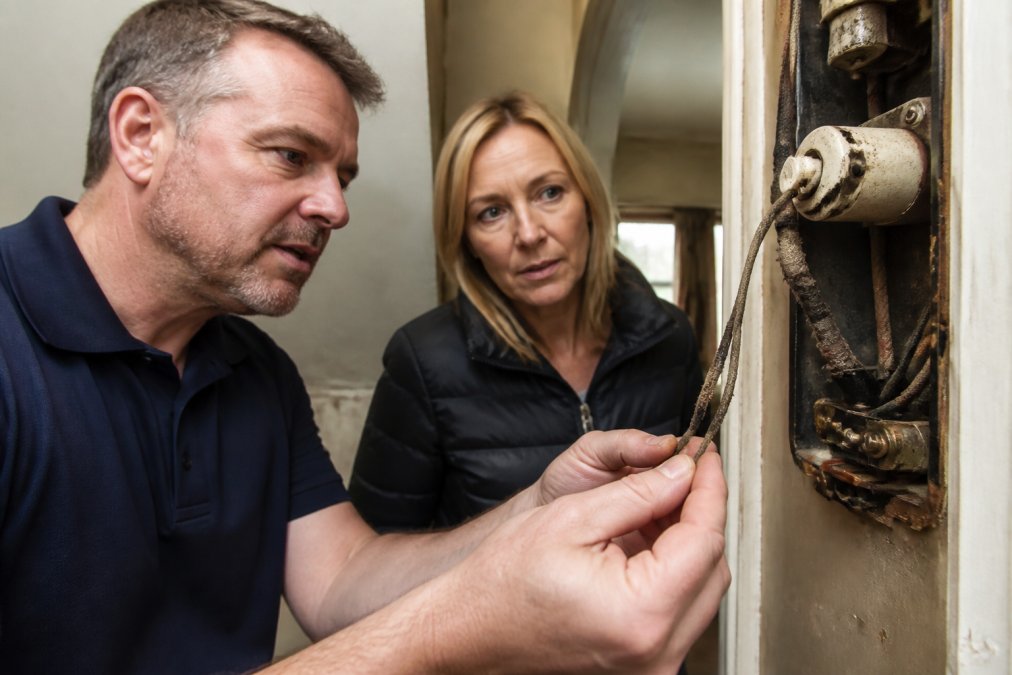
Cloth-insulated or knob-and-tube wiring
Cloth-insulated wiring is exactly what it sounds like: copper wires wrapped in cloth. It was standard in homes built before the 1950s. The cloth degrades over time, it becomes brittle, cracks, and falls away. Exposed copper is a fire and electrocution hazard.
Knob-and-tube wiring is even older. It uses ceramic knobs to hold wires away from wooden beams. There's no conduit. The wires are completely exposed. Modern building standards banned this system decades ago.
If you find either of these in your house, you need rewiring. These systems can't handle modern electrical loads. They're fire hazards. Insurance companies often refuse to cover homes with knob-and-tube wiring.
Signs of old wiring like this are the strongest reason to rewire your property.
Aluminium wiring
Aluminium wiring was used in some homes built in the 1960s and 1970s. It's cheaper than copper, but it has serious problems.
Aluminium oxidises. It corrodes at connection points. It expands and contracts more than copper, which loosens connections over time. Loose connections generate heat. Heat can start fires.
Aluminium wiring also requires special outlets and switches designed for aluminium. Standard outlets and switches don't work safely with aluminium wire.
If your house has aluminium wiring, you should replace it. This is a major undertaking, but it's necessary for safety. Many insurance companies will not insure homes with aluminium wiring.
Two-pin sockets instead of three-pin
Old UK homes used two-pin sockets. Three-pin sockets have an earth pin for grounding, a critical safety feature.
Two-pin sockets mean your house lacks proper earthing. Without earthing, fault current can't flow safely to ground. A fault in an appliance could cause electrocution.
If your house still has two-pin sockets, you need rewiring to add earthing. This is not optional. Modern appliances require earthing. Two-pin sockets are a safety hazard.
How Long Does a House Rewire Take?
A full house rewire typically takes 1 to 3 weeks, depending on the size of the property and the complexity of the work.
Several factors affect the timeline:
- House size: A small flat might take 5-7 days. A four-bedroom house might take 2-3 weeks.
- Type of wiring: Replacing cloth-insulated wiring takes longer than upgrading modern wiring.
- Access: If electricians can easily reach walls and ceilings, work moves faster. Listed buildings or properties with plaster work take longer.
- Disruption: Minimising disruption to tenants or residents adds time.
- Additional work: If the electrician finds structural damage or asbestos, the job takes longer.
Test My Electrics aims to minimise disruption during rewiring. We plan the work carefully and will discuss the timeline with you before we start.
Most rewires happen room by room. You might lose power to one area while another stays live. We coordinate with you to make sure the schedule works for your household.
Electrical Installation Condition Report Cost and What It Reveals
An Electrical Installation Condition Report (EICR) is a thorough inspection of your electrical system. It's the first step if you suspect problems.
An EICR identifies:
- Outdated wiring and components
- Unsafe connections
- Overloaded circuits
- Missing earthing
- Fire and electrocution hazards
- What needs replacing immediately versus what can wait
The report gives you a clear picture of your electrical system's condition.
Why Outdated Wiring Poses Real Dangers
Old wiring isn't just inconvenient. It's genuinely dangerous.
Fire risk: Deteriorated insulation and loose connections generate heat. Heat ignites nearby materials. Electrical fires spread quickly and are hard to extinguish.
When to Call a Professional Electrician
You should call a professional electrician immediately if you notice:
- Burning smells near outlets or switches
- Scorched or discoloured outlet plates
- Outlets or switches that feel hot
- Frequent circuit breaker trips
- Flickering or dimming lights
- Cloth-insulated, knob-and-tube, or aluminium wiring
- Two-pin sockets in an older property
- Sparks when you plug something in
You should also call if:
- Your home is over 40 years old and has never had an EICR
- You're buying a property and want a pre-purchase inspection
- You're renting out a property and need compliance certification
- You're planning renovations and need to upgrade your electrical system
Frequently Asked Questions
How do I know if my house wiring is dangerous?
Dangerous wiring often shows clear warning signs: frequent circuit breaker trips, flickering lights, burning smells near outlets, warm switches, or visible scorch marks. If your home is over 30 years old and has never been inspected, the wiring itself may be deteriorated even if you haven't noticed problems yet. An Electrical Installation Condition Report from a qualified electrician is the definitive way to identify hazards before they cause a fire or electric shock.
How long does a house rewire take?
A full house rewire typically takes one to three weeks, depending on the property size, layout, and whether walls need opening. A small flat might take five to ten days, whilst a larger detached house could take longer. The timeline also depends on whether new consumer units, earthing systems, or additional circuits are needed. Your electrician can provide a more precise estimate after assessing your property.
What does an Electrical Installation Condition Report cost?
An EICR is an essential inspection that identifies whether your electrical system is safe and compliant. The cost varies based on property size and complexity, so it's worth getting a quote from a qualified electrician. This inspection is legally required for rental properties and is highly recommended before buying a home or undertaking renovations. Contact a professional electrician for a personalised quote.
Can I rewire my house myself under building regulations?
No. All electrical work in your home must be carried out by a qualified electrician registered with a competent person scheme such as NAPIT. Building Regulations require that any rewiring work meets current standards and is certified by a qualified professional. Attempting DIY rewiring puts your property and occupants at serious risk and will not meet legal requirements for insurance or selling the property.