 how-to
Is an EICR Mandatory for Landlords? A 2026 Guide
Table of Contents
- Is an EICR Mandatory for Landlords? The Legal Position
- How Often Do Landlords Need an EICR?
- What Happens During an EICR Inspection
- Penalties for Missing EICR: Fines, Enforcement and Insurance
- Your Step-by-Step Route to EICR Compliance
- Common Mistakes Landlords Make With EICRs
- Frequently Asked Questions
Last Updated: 11 September 2026
Is an EICR Mandatory for Landlords? The Legal Position
Yes. If you let property in the private rented sector, an EICR mandatory rule applies to landlords, and it is enforced under the Electrical Safety Standards in the Private Rented Sector (England) Regulations 2020. This guide explains what that duty actually requires of you.
An Electrical Installation Condition Report (EICR) is a formal inspection and testing document that records the condition of the fixed electrical installation in a property and confirms whether it is safe to remain in use.
The requirement isn't a one-off. You must have the installation inspected and tested at least every five years by a qualified person, and the report has to be supplied to tenants before they move in (gov.uk). Get this wrong and you are not dealing with a paperwork slip. It is a legal breach with real consequences.
Which Properties and Tenancy Types Are Covered
The duty applies to most private tenancies, but not every arrangement. It covers assured shorthold tenancies, most assured tenancies, and licences to occupy where the occupier treats the property as their main home.
It does not apply to social housing, to lodgers sharing your own home, or to long leases of seven years or more. Student halls of residence and certain other purpose-built accommodation sit outside the regime too.
If you are unsure which category your let falls into, check the government guidance on electrical safety standards in the private rented sector before assuming you are exempt.
What Counts as a Satisfactory Report
A satisfactory report means the installation has been inspected and tested and no code C1 (danger present) or C2 (potentially dangerous) defects were found. Those two codes make a report unsatisfactory, and that triggers an obligation to act.
C3 findings are "improvement recommended". They do not make the report unsatisfactory on their own, but they are worth fixing when you next have work done.
How Often Do Landlords Need an EICR?
The legal maximum interval is five years, but the report itself can shorten that. If the electrician records a shorter "next inspection due" date, that becomes your deadline, not the five-year default.
So the honest answer to how often do landlords need an EICR is: every five years at most, and sooner if the report says so. New tenancies also need a fresh inspection before the tenant moves in if the existing report is out of date or missing.
Keep a simple tracker. For a small portfolio, a spreadsheet with property address, last test date, and next due date is enough. For larger portfolios, a calendar reminder set 60 days before expiry stops you scrambling.
What Happens During an EICR Inspection
A qualified electrician inspects and tests the fixed wiring, accessories, and protective devices at the property, then issues a report with a clear satisfactory or unsatisfactory outcome. The visit covers the consumer unit, circuits, sockets, switches, earthing, and bonding.
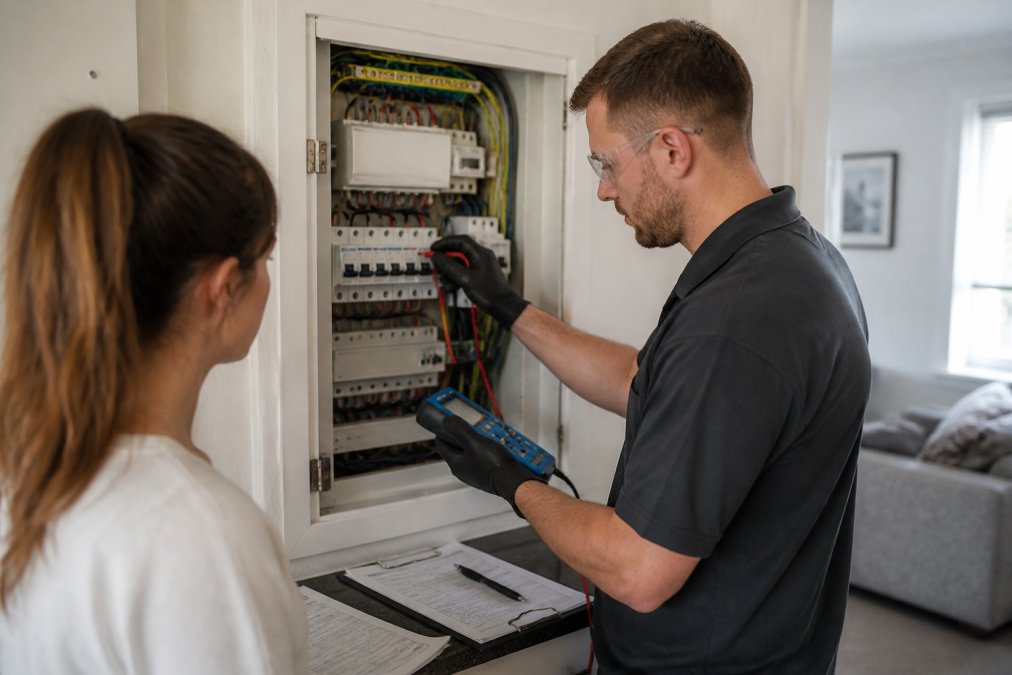
The inspection is not a sales exercise. An electrician reports what the regulations require and nothing more. Be wary of anyone who turns a routine test into a full rewire quote on the spot.
How Long It Takes and What Access Is Needed
A typical flat or small house takes one to two hours. Larger or older properties with multiple circuits take longer.
You need to arrange access to the whole property, including every room and the consumer unit. Tenants should be told in advance so they can clear access to sockets and the meter cupboard.
Penalties for Missing EICR: Fines, Enforcement and Insurance
Local authorities can serve a remedial notice requiring you to fix defects, and they can impose a financial penalty of up to £30,000 for breaches (gov.uk). They can also arrange the work themselves and recover the cost from you.
That figure is the headline, but the quieter risk is insurance. Many landlord policies require a valid EICR, and a claim following an electrical fire can be refused if you cannot produce one.
Your Step-by-Step Route to EICR Compliance
Compliance is a short, repeatable process once you know the sequence. Work through it in this order and you will not miss a step.
- Identify every let property and confirm which tenancies fall under the regulations.
- Check the current report for the inspection date and the next due date.
- Book a qualified electrician with the right certifications and insurance.
- Arrange tenant access and give reasonable notice.
- Review the report and note any C1, C2, or C3 findings.
- Complete remedial work within the deadline set by the notice or report.
- Obtain written confirmation that the work is done.
- Serve the report on existing tenants and new tenants.
- Retain copies and set a reminder for the next due date.
At Test My Electrics, we handle EICRs across [EICR services | testmyhouse.co.uk] for landlords managing single properties and larger portfolios alike, with clear reporting and no pressure to add work you do not need.
Recording, Sharing and Retaining the Report
Give a copy of the report to each existing tenant within 28 days of the inspection. For a new tenancy, provide it before the tenant moves in.
You must also give a copy to the local authority if they ask for it, and to any prospective tenant who requests one in writing. Keep your own copy until the next inspection, and pass copies on if you sell the property.
Common Mistakes Landlords Make With EICRs
The same errors come up again and again, and most are avoidable with a little forward planning.
- Treating it as a one-off. The report has an expiry date. Diarise it.
- Ignoring C3 findings forever. They are recommendations, but they tend to become C2s over time.
- Skipping remedial work. An unsatisfactory report with no action taken is a live breach.
- Using an unqualified tester. The work must be done by a competent person, and cheap inspections often miss defects.
- Failing to serve the report. Inspecting without sharing the document does not satisfy the duty.
The real difference between a smooth compliance record and a stressful one comes down to one habit: treating the EICR as a recurring task, not a box you tick once.
Landlord compliance is only as strong as the paperwork behind it, and an EICR that is out of date or missing leaves you exposed to enforcement and insurance problems. Test My Electrics provides comprehensive EICRs with an integrity-first approach, £10 million insurance cover, and a local team serving Ayrshire and the West of Scotland. Our engineers are SELECT and NAPIT registered, 18th Edition qualified, and hold C&G 2391-51 and C&G 2391-52 certification. Book an electrician today and get a clear, honest report on your property's electrical safety.
Frequently Asked Questions
What happens if a landlord does not have an EICR?
Local authorities can serve a remedial notice requiring work within 28 days. Failing to comply can lead to a civil penalty of up to £30,000 per breach, and councils may arrange the work themselves and recover costs. You also risk invalidating landlord insurance and, in serious cases, facing prosecution if a tenant is harmed by a fault that an inspection would have identified.
Does an EICR cover portable appliances?
No. An EICR checks the fixed wiring and installation, such as consumer units, sockets, light fittings and earthing. Portable appliances like kettles, toasters and plug-in heaters need separate PAT testing. Many landlords arrange both together, but they are distinct checks with different certificates, and only the fixed installation falls under the mandatory five-year rule.
Are there exemptions for EICR requirements in rental properties?
Few genuine exemptions exist. The duty applies to most private rented homes in England and Scotland, including flats and houses in multiple occupation. A qualified electrician may state that the installation is safe but not due for testing yet. Lodger arrangements where the landlord lives in the property are generally treated differently. Always confirm your specific situation with your local authority or a registered electrician.
What is the difference between an EIC and an EICR?
An EIC, or Electrical Installation Certificate, is issued when new wiring or a new circuit is installed. An EICR, or Electrical Installation Condition Report, assesses the condition of existing wiring against current safety standards. Landlords need an EICR every five years, while an EIC is provided after installation work such as a rewire or a new consumer unit.