 how-to
How to Identify Electrical Hazards: A 2026 UK Safety Guide
Table of Contents
- What You'll Need Before You Start
- How to Identify Electrical Hazards: Step-by-Step
- Signs of Faulty Wiring in Old Houses
- Common Mistakes to Avoid When Checking for Electrical Hazards
- How Long Does a House Rewire Take?
- Electrical Installation Condition Report Cost: What Affects the Price
- When to Call a Qualified Electrician
- Frequently Asked Questions
Last Updated: September 16, 2026
What You'll Need Before You Start
Knowing how to identify electrical hazards starts with a short, honest conversation about your own limits. Visual checks are safe and useful. Anything involving the inside of a consumer unit, a screwdriver, or a multimeter belongs to a registered electrician.
Gather these first:
- A torch or phone light
- A socket tester (the plug-in type, no contact needed)
- A notepad or phone for photos and dates
- Your last Electrical Installation Condition Report, if you have one
- The number of a registered electrician
How to Identify Electrical Hazards: Step-by-Step
The method below is the same one our engineers use on a first walk-through. Work through it room by room, and write down anything that looks, smells, or feels wrong.
Step 1: Check Your Consumer Unit and Fuse Box
Start at the consumer unit. Look for a burnt smell, scorch marks, or a fuse that keeps tripping. If a breaker trips repeatedly, stop resetting it and book an inspection.
Old fuse boxes with rewireable fuses and no RCD protection are a red flag. The electrical safety guidance from the Health and Safety Executive is clear that installations must be maintained to prevent danger, and older boards make that harder to guarantee.
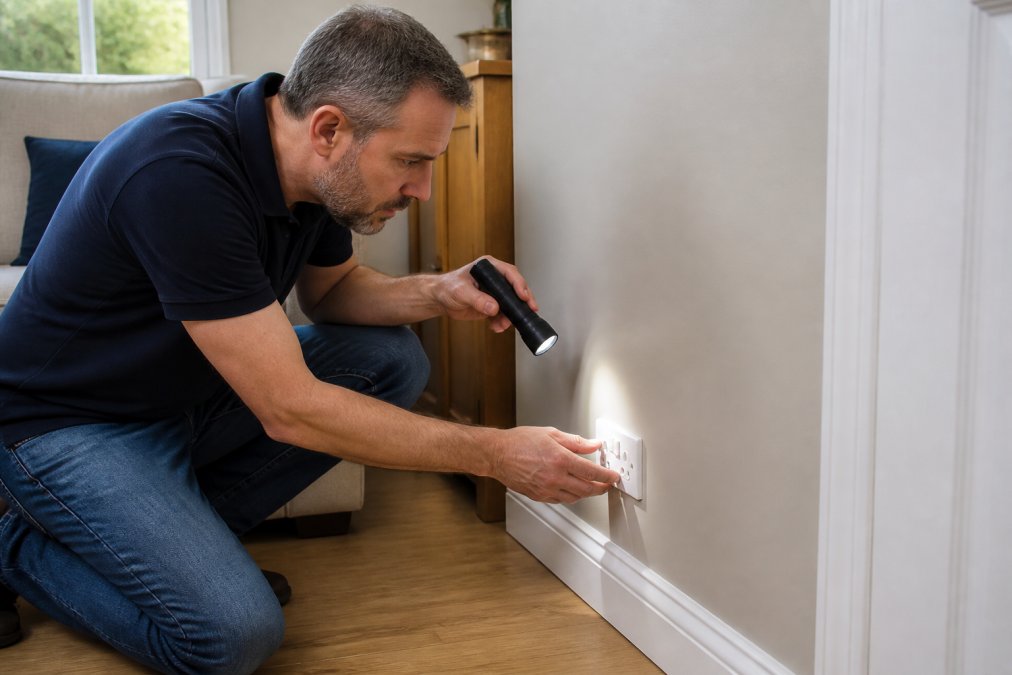
Step 2: Inspect Sockets, Switches and Cables
Walk each room and check for sockets that are warm, cracked, or loose in the wall. Look at plugs for brown scorching around the pins. Run your eyes along visible cables for nicks, rodent damage, or cables trapped under doors and carpets.
A plug-in socket tester gives a quick read on wiring polarity. It won't catch everything, but it flags the obvious faults in seconds.
Step 3: Look for Signs of Overheating and Burning
Overheating leaves evidence. Check for discoloured faceplates, a fishy or burning smell near outlets, and lights that flicker when appliances switch on. Any of these means the circuit is struggling and needs professional attention.
Signs of Faulty Wiring in Old Houses
Older properties hide their problems well. The classic signs of faulty wiring in old houses include rubber-insulated cables that crumble when touched, blackened cable ends, and no earth wire at lighting points. Fuse boxes from the 1960s and earlier rarely meet modern standards.
Period properties in this region often have a mix of old and new circuits, added over decades by different hands. That patchwork is where faults hide. A full inspection tells you what you're actually living with.
Common Mistakes to Avoid When Checking for Electrical Hazards
The biggest mistake is treating a tripping breaker as a nuisance rather than a warning. A breaker that trips is doing its job. Reset it once; if it trips again, call someone.
Other frequent errors:
- Assuming a recently decorated house has safe wiring underneath
- Relying on a socket tester as a full inspection
- Ignoring warning signs because "it's always been like that"
- Trying DIY fixes on live circuits
How Long Does a House Rewire Take?
A full rewire typically takes one to three weeks for an average three-bedroom house, depending on size, access, and how much of the old system can be reused. Occupied homes usually take longer because work is staged around daily life.
The honest answer is that how long a house rewire takes depends on what's behind the walls. Plaster, period features, and hidden junctions all add time. Test My Electrics plans rewires in phases so families can stay put with minimal disruption.
Electrical Installation Condition Report Cost: What Affects the Price
Electrical Installation Condition Report cost varies with property size, age, circuit count, and access. A small flat takes far less time than a large period property with outbuildings.
Pricing depends on the number of circuits, the age and condition of the installation, and how easily the engineer can reach every point. We don't quote blind. For current pricing, check our EICR service page or request a quote.
When to Call a Qualified Electrician
Call a registered electrician immediately if you find burning smells, scorch marks, exposed live conductors, or a consumer unit that won't reset. These aren't wait-and-see problems.
For everything else, a periodic inspection gives you a clear picture. Test My Electrics is UKAS accredited, SELECT and NAPIT registered, and fully insured with £10 million cover. Our reports tell you what's essential versus nice-to-have, with no pressure to upsell. We serve homeowners, landlords, and businesses across the region, and you can book an electrician for a straightforward assessment.
Frequently Asked Questions
What are the most common signs of electrical hazards in a house?
The most common signs include flickering or dimming lights, sockets that feel warm to the touch, a burning smell near outlets or the consumer unit, frequent tripping of circuit breakers, and visible scorch marks around plugs. Buzzing sounds from switches or sockets also indicate a problem. If you notice any of these, stop using the affected circuit and arrange an inspection by a qualified electrician.
How can I tell if my wiring is dangerous?
Dangerous wiring often shows physical signs: cracked or perished cable insulation, exposed conductors, outdated fuse boxes with rewireable fuses, and sockets that crackle when you plug something in. In older properties, black rubber cables or lead-sheathed wiring are strong indicators that a rewire is overdue. A periodic inspection is the only reliable way to confirm whether your wiring is safe.
What should I look for during a visual electrical inspection?
Check for damage to sockets, switches and cables, signs of overheating such as discolouration or melted plastic, and whether your consumer unit has RCD protection. Look for cables that are damaged by nails, screws or furniture, and check that outdoor sockets have weatherproof covers. Also confirm that light fittings match the correct bulb wattage. Anything that looks burnt, smells odd or feels hot needs professional attention.
How often should I have my electrical system tested?
The Institution of Engineering and Technology recommends testing every 10 years for owner-occupied homes and every 5 years for rented properties. If you are a landlord, you are legally required to have an EICR every 5 years under the Electrical Safety Standards in the Private Rented Sector (England) Regulations 2020, with equivalent duties in Scotland. Older properties or those with previous faults may need testing more frequently.
Electrical faults rarely announce themselves. They smoulder quietly until something fails, and by then the cost is measured in more than money. If your walk-through turned up anything on this list, don't sit on it. Test My Electrics provides comprehensive EICRs, honest reporting, and rewiring planned around your life, backed by a 4.9 rating from 321 reviews. Get started with Test My Electrics and know exactly what's running behind your walls.